
Success is not just about scoring high marks or getting into a good college. True success also includes mental peace, confidence, good health, and the ability to handle life’s challenges with strength and clarity. For students, balancing academic goals with personal wellbeing is essential. A student may be intelligent and hardworking, but without emotional balance and healthy habits, long-term success becomes difficult.
The habits students build during their school and college years often shape the rest of their lives. These years are not only about education but also about forming attitudes, values, and daily practices that influence future careers and personal happiness.
Many students believe success comes from last-minute studying, stress, pressure, or sacrificing sleep. Some feel that staying awake all night or studying continuously without breaks is the only way to achieve good results. In reality, success and wellbeing grow from small, consistent habits practiced daily. These habits don’t require special talent or luck-only commitment, awareness, and discipline.
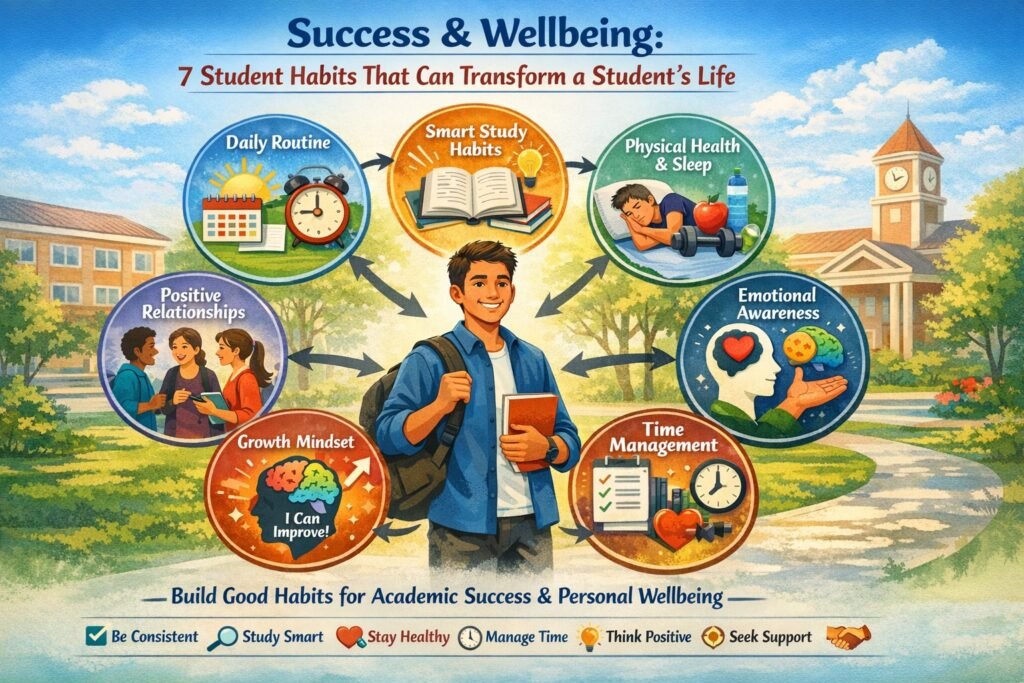
Here are seven powerful student habits that can truly transform a student’s life, helping them grow academically, emotionally, and personally.
1. Developing a Consistent Daily Routine
A consistent routine creates structure and stability in a student’s life. When students wake up, study, eat, and sleep at regular times, their body and mind begin to function more efficiently. A routine helps students avoid unnecessary stress caused by poor planning and irregular schedules.
Students with a fixed routine are less likely to procrastinate. They clearly know when it’s time to study and when it’s time to rest. This balance prevents burnout and keeps motivation steady over time. A predictable routine also helps students develop discipline, which is essential for long-term success.
A good daily routine should include:
- Fixed wake-up and sleep times
- Scheduled study hours
- Breaks for rest, hobbies, or relaxation
- Time for meals and physical activity
Having a routine does not mean life becomes boring or restricted. Instead, it creates freedom by reducing confusion and saving mental energy. Students who follow a routine often feel more confident, organized, and in control of their day. Even starting with a simple routine can bring noticeable improvements in focus, energy levels, and productivity.
2. Practicing Smart Study Habits Instead of Long Hours
Studying for long hours does not always result in effective learning. Many students spend hours reading books or notes but struggle to recall information later. Smart study habits focus on understanding concepts deeply rather than studying endlessly.
Effective study habits include:
- Studying in short, focused sessions
- Revising regularly instead of last-minute cramming
- Understanding concepts rather than memorizing blindly
- Practicing with examples, problems, and questions
Techniques such as active recall, mind mapping, summarizing topics in one’s own words, and teaching concepts to others can significantly improve learning. Taking short breaks between study sessions refreshes the brain and improves concentration.
Students who practice smart study habits feel more confident during exams and experience less fear and anxiety. Over time, learning becomes easier, faster, and more enjoyable, turning studies into a positive experience rather than a stressful task.
3. Prioritizing Physical Health and Sleep
Good health is the foundation of success. Many students ignore sleep, exercise, and nutrition while focusing only on academic performance. This often leads to fatigue, weak concentration, mood swings, and high stress levels.
Sleep plays a critical role in learning and memory. A well-rested brain processes information better, improves focus, and makes clearer decisions. Students who get proper sleep perform better in exams and feel emotionally balanced.
Healthy habits students should focus on:
- Getting 7–9 hours of sleep daily
- Eating balanced meals with fruits and vegetables
- Drinking enough water throughout the day
- Engaging in light physical activity like walking, yoga, or stretching
Physical health and mental wellbeing are closely connected. When the body feels strong and energized, the mind naturally becomes calmer and sharper. Students who care for their health build endurance, confidence, and long-term productivity.
4. Building Emotional Awareness and Mental Strength
Academic success alone does not prepare students for real-life challenges. Emotional intelligence plays a major role in handling stress, relationships, failure, and pressure. Students face expectations from parents, competition among peers, exam pressure, and the influence of social media.
Learning to understand emotions helps students manage stress and respond calmly during difficult situations. Emotional awareness allows students to recognize their feelings instead of ignoring or suppressing them.
Key emotional habits include:
- Accepting failures as learning experiences
- Talking openly about stress instead of hiding it
- Practicing gratitude and positive thinking
- Seeking help when feeling overwhelmed
Mental strength does not mean avoiding emotions or pretending to be strong. It means understanding emotions and responding in healthy, constructive ways. Students who develop emotional awareness become more resilient, confident, and better equipped to handle both success and failure.
5. Managing Time and Avoiding Procrastination
Time management is one of the most valuable life skills a student can learn. Poor time management often leads to stress, rushed work, missed deadlines, and regret. Many students delay tasks until the last moment, increasing pressure unnecessarily.
Successful students manage their time wisely. They plan ahead, break tasks into smaller steps, and set realistic deadlines. Instead of waiting for motivation, they take small, consistent actions.
Simple time management practices include:
- Making daily or weekly to-do lists
- Setting priorities based on importance and urgency
- Completing difficult tasks when energy levels are high
- Reducing distractions such as excessive phone or social media use
When students manage time effectively, they feel more in control of their responsibilities. This sense of control improves confidence, reduces anxiety, and creates a healthy balance between academics and personal life.
6. Developing a Growth Mindset and Love for Learning
Time management is one of the most valuable life skills a student can learn. Poor time management often leads to stress, rushed work, missed deadlines, and regret. Many students delay tasks until the last moment, increasing pressure unnecessarily.
Successful students manage their time wisely. They plan ahead, break tasks into smaller steps, and set realistic deadlines. Instead of waiting for motivation, they take small, consistent actions.
Simple time management practices include:
- Making daily or weekly to-do lists
- Setting priorities based on importance and urgency
- Completing difficult tasks when energy levels are high
- Reducing distractions such as excessive phone or social media use
When students manage time effectively, they feel more in control of their responsibilities. This sense of control improves confidence, reduces anxiety, and creates a healthy balance between academics and personal life.
7. Maintaining Positive Relationships and Seeking Support
No student succeeds alone. Support from friends, teachers, parents, and mentors plays a crucial role in a student’s journey. Positive relationships provide encouragement, guidance, and emotional safety.
Discussing challenges with trusted people helps students gain new perspectives and reduce stress. A supportive environment boosts confidence and motivation.
Healthy relationship habits include:
- Respectful communication
- Asking for help without hesitation
- Supporting peers instead of competing negatively
- Spending time with people who encourage personal growth
Students who build strong support systems feel less lonely and more confident. They learn teamwork, empathy, and communication-skills that are essential for both professional and personal success.
How These Habits Transform a Student’s Life
When students consistently practice these seven habits, the transformation is gradual but powerful. They become more organized, confident, emotionally balanced, and self-aware. Academic performance improves naturally because the mind is calm, focused, and disciplined.
These habits also prepare students for life beyond exams. They learn responsibility, resilience, self-care, and adaptability-qualities that matter in careers, relationships, and personal growth.
Most importantly, students begin to enjoy their journey instead of constantly feeling pressured. Success becomes sustainable, and wellbeing becomes a priority rather than an afterthought
Conclusion
Success and wellbeing go hand in hand. A student who is mentally healthy, physically active, emotionally aware, and disciplined is more likely to achieve long-term success. The habits formed during student life shape character, mindset, and future decisions.
By building a routine, studying smartly, caring for health, managing time, strengthening emotional intelligence, embracing learning, and nurturing relationships, students can truly transform their lives.
These habits don’t require perfection-only consistency. Small daily efforts lead to big, lasting changes. When students focus on both success and wellbeing, they don’t just build a career-they build a meaningful, balanced, and fulfilling life.
Contact Us
At Gurajada School, we believe a child’s growth is a shared journey between the school and parents. If you are seeking guidance on child development, communication skills, academic support, or parenting, our team is always happy to assist you.
Get in Touch
📧 Email: gurajadaschools@gmail.com
📞 Phone: +91 94912 71151
🌐 Website: www.gurajadaschool.in
For more information, please visit our website and click on the Contact Us section.
We are here to support you and your child at every step of their learning and growth journey.