
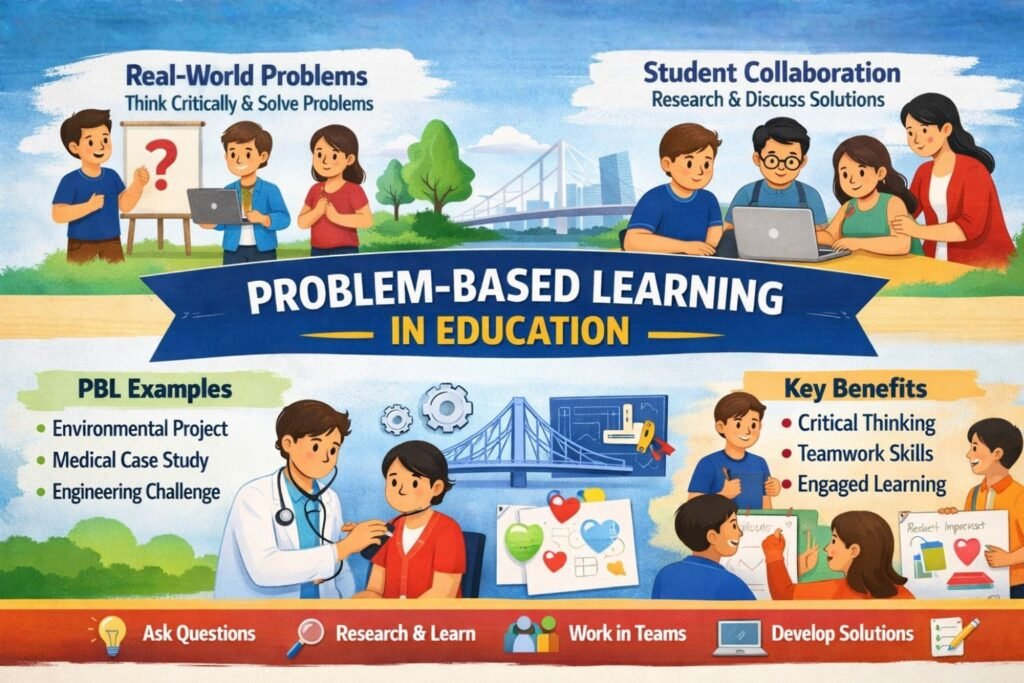
Education is changing fast. Today, students are expected to think critically, solve real-world problems, and apply knowledge instead of just memorizing facts. One teaching method that supports this shift is Problem-Based Learning (PBL). It focuses on learning through real-life problems, making students active participants in the learning process.
In this blog, we’ll explore Problem Based Learning in education, explain the Problem Based Learning approach, share 5 best Problem Based Learning examples, discuss effective Problem Based Learning strategies, and highlight key Problem Based Learning benefits.
What is Problem-Based Learning?
Problem-Based Learning is a student-centered teaching method where learning starts with a problem instead of a lecture. Students are given a real or realistic problem and are encouraged to research, discuss, collaborate, and propose solutions.
Instead of the teacher explaining everything, students:
- Ask questions
- Identify what they already know
- Discover what they need to learn
- Apply knowledge to solve the problem
This makes learning meaningful, practical, and engaging.
Problem Based Learning in Education
Problem Based Learning in education is widely used in schools, colleges, and professional training programs. It helps bridge the gap between theory and practice.
In traditional classrooms, students often memorize content for exams. In contrast, PBL focuses on:
- Real-life applications
- Critical thinking
- Teamwork
- Independent learning
This approach is commonly used in:
- Medical education
- Engineering and technology courses
- Business and management studies
- School-level science and social studies
By involving students in real-world challenges, education becomes more relevant and impactful.
The Problem Based Learning Approach
The Problem Based Learning approach follows a structured but flexible process. While it may vary slightly across institutions, the core steps usually include:
- Presenting the Problem
Students are introduced to a complex, open-ended problem related to real life. The problem does not have a single correct answer.
- Identifying What is Known and Unknown
Students discuss what they already know and what they need to learn to solve the problem.
- Research and Self-Directed Learning
Students research independently or in groups using books, online resources, interviews, or experiments.
- Developing Solutions
Based on their findings, students propose possible solutions and evaluate their effectiveness.
- Reflection and Feedback
Students reflect on what they learned, how they worked as a team, and how their understanding improved.
This approach helps students take responsibility for their own learning.
5 Best Problem Based Learning Examples
Let’s look at 5 effective Problem Based Learning examples that can be used across different educational levels.
1. Environmental Pollution Project (School Level)
Problem:
A local river is polluted, affecting nearby villages.
Student Tasks:
- Identify causes of pollution
- Research environmental laws
- Propose solutions like waste management or awareness campaigns
Learning Outcome:
Students learn science, social responsibility, teamwork, and communication skills.
This is a strong example of Problem Based Learning in education because it connects classroom knowledge with real-life issues.
2. Medical Diagnosis Case Study (Medical Education)
Problem:
A patient shows multiple symptoms, but the diagnosis is unclear.
Student Tasks:
- Analyze symptoms
- Study possible diseases
- Suggest diagnostic tests and treatment plans
Learning Outcome:
Students develop clinical reasoning, research skills, and decision-making abilities.
This is one of the most common Problem Based Learning examples used in medical colleges worldwide.
3. Business Startup Challenge (College Level)
Problem:
Create a startup idea with limited capital and high competition.
Student Tasks:
- Conduct market research
- Develop a business plan
- Analyze risks and profits
Learning Outcome:
Students gain real-world business knowledge and entrepreneurial skills.
This example shows how the Problem Based Learning approach prepares students for professional challenges.
4. Engineering Design Problem
Problem:
Design a low-cost bridge for a rural area using limited materials.
Student Tasks:
- Apply physics and math concepts
- Create design models
- Test and improve solutions
Learning Outcome:
Students learn problem-solving, creativity, and technical skills.
This is a practical example of Problem Based Learning strategies in technical education.
5. Community Health Awareness Campaign
Problem:
Low vaccination awareness in a local community.
Student Tasks:
- Research health data
- Create awareness materials
- Plan campaigns or presentations
Learning Outcome:
Students improve research, public speaking, and social awareness.
This example highlights both Problem Based Learning benefits and social responsibility.
Effective Problem Based Learning Strategies
To successfully implement PBL, educators must use the right Problem Based Learning strategies. Here are some proven strategies:
- Improves Critical Thinking
Students analyze problems, evaluate options, and make informed decisions.
- Enhances Problem-Solving Skills
Learners practice solving real-world challenges, preparing them for future careers.
- Encourages Independent Learning
Students take responsibility for researching and understanding concepts.
- Builds Communication and Teamwork
Group work improves collaboration, leadership, and interpersonal skills.
- Increases Student Engagement
Learning becomes interesting and meaningful, reducing boredom and passive learning.
- Connects Theory with Practice
Students understand how classroom concepts apply in real-life situations.
These Problem Based Learning benefits make it one of the most effective modern teaching methods.
Challenges in Problem-Based Learning and How to Overcome Them
While powerful, PBL has some challenges:
Time-Consuming
Solution: Start with small problems and gradually expand.
Student Confusion
Solution: Provide clear guidance and structured steps.
Assessment Difficulties
Solution: Use rubrics, peer evaluation, and reflections.
With proper planning, these challenges can be managed effectively.
Problem-Based Learning at Gurajada School
At Gurajada School, Problem-Based Learning is not just a method-it is part of the school’s teaching philosophy. The school believes that students learn best when they actively engage with real-life situations, think independently, and work together to find solutions.
By integrating Problem Based Learning in education, Gurajada School encourages students to move beyond rote learning and develop strong thinking, reasoning, and decision-making skills. Teachers design classroom activities and projects that follow the Problem Based Learning approach, where students explore problems related to their environment, community, and daily life.
Through well-planned classroom activities, group discussions, projects, and presentations, Gurajada School implements effective Problem Based Learning strategies that help students:
- Ask meaningful questions
- Apply concepts practically
- Collaborate confidently with peers
- Reflect on their learning
The school regularly uses age-appropriate Problem Based Learning examples, such as environmental awareness projects, health and hygiene activities, mathematical problem-solving tasks, and community-based learning initiatives. These experiences help students clearly understand concepts and see the relevance of education in real life.
As a result, students at Gurajada School experience strong Problem Based Learning benefits, including improved critical thinking, better communication skills, increased confidence, and a deeper interest in learning. This approach prepares them not only for academic success but also for real-world challenges.
By adopting Problem-Based Learning, Gurajada School continues its commitment to holistic education-nurturing curious minds, responsible citizens, and confident learners ready for the future.
Role of Teachers and Parents in Problem-Based Learning
The success of Problem-Based Learning depends not only on students but also on the active involvement of teachers and parents. Teachers play a key role as facilitators by creating meaningful problem scenarios, guiding discussions, and encouraging students to think independently rather than providing ready-made answers. Their support helps students stay focused and confident throughout the learning process.
Parents also contribute by encouraging curiosity at home, discussing real-life problems with their children, and supporting project-based activities. When learning continues beyond the classroom, students develop a deeper understanding and stronger interest in their studies. This shared effort strengthens the impact of the Problem Based Learning approach and ensures long-term learning success.
Conclusion
Problem-Based Learning is more than a teaching method—it is a mindset that prepares students for real life. By focusing on real-world problems, collaboration, and critical thinking, the Problem Based Learning approach transforms education from passive listening to active discovery.
Through practical Problem Based Learning examples, effective Problem Based Learning strategies, and clear Problem Based Learning benefits, educators can create engaging and meaningful learning experiences.
As education continues to evolve, Problem Based Learning in education will play a crucial role in shaping confident, capable, and problem-solving learners.
Contact Us
At Gurajada School, we believe that a child’s growth is a shared journey between the school and parents. If you are looking for guidance on child development, communication skills, academic support, or parenting, we are always happy to help.
Get in touch with us:
📧 Email: gurajadaschools@gmail.com
📞 Phone: +91 9491271151
🌐 Website: www.gurajadaschool.in
For more details, visit our website and click on the Contact Us section.
We’re here to support you and your child at every step of their learning and growth journey.