
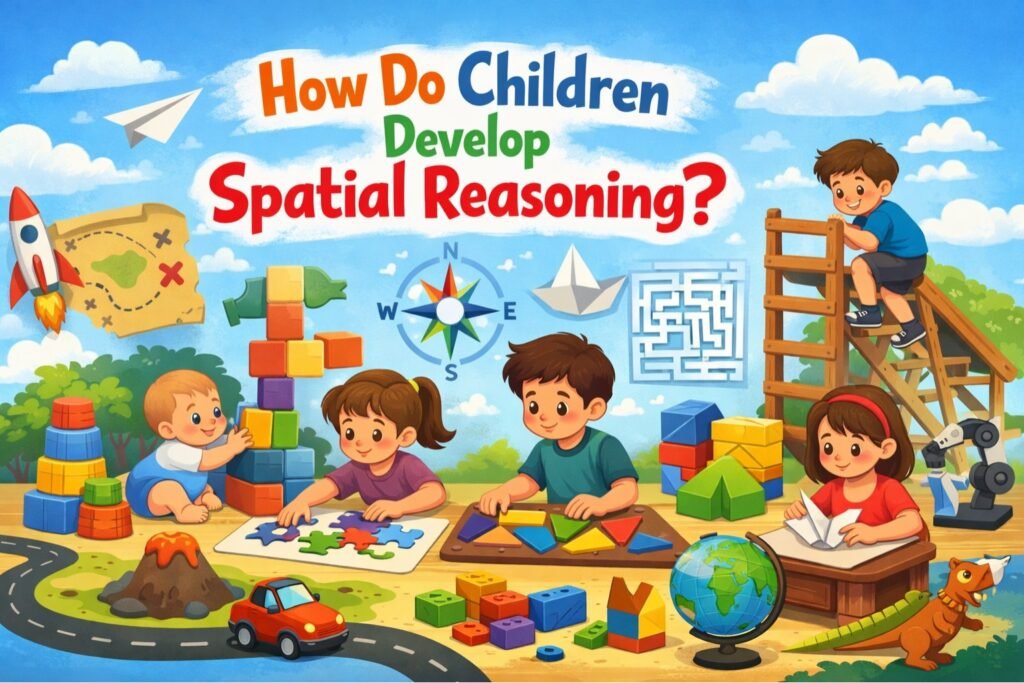
Spatial reasoning is the ability to understand how objects move and fit in space. It helps children recognize shapes, judge distances, read maps, solve puzzles, and even understand math concepts later in life. From stacking blocks to drawing pictures, children build this skill naturally through everyday experiences.
Let’s take a closer look at how spatial reasoning skills develop and how parents and teachers can support this important part of learning.
What Are Spatial Reasoning Skills?
Spatial reasoning skills allow children to:
- Understand where objects are placed
- Visualize how things look from different angles
- Recognize patterns and shapes
- Solve problems involving direction and movement
For example, when a child rotates a puzzle piece to make it fit, they are using spatial thinking. When they build a tower without it falling, they are judging balance and space. These simple actions are powerful steps in brain development.
Early Childhood Spatial Development
Early childhood spatial development begins much earlier than many people realize. Even babies start learning about space when they reach for toys, crawl toward objects, or watch things move around them.
- Infancy (0–2 years)
At this stage, children explore through touch and movement. They learn:
- Object permanence (understanding that objects still exist even when hidden)
- Distance and depth
- Size differences
Simple activities like stacking cups or playing peek-a-boo help develop early spatial understanding.
- Toddler Years (2–4 years)
Toddlers begin sorting shapes, stacking blocks, and solving simple puzzles. They start using words like:
- Big and small
- Under and over
- Inside and outside
These words strengthen brain connections related to space and position.
- Preschool Years (4–6 years)
During this period, children improve their ability to:
- Visualize shapes
- Follow directions
- Recognize patterns
- Understand left and right
Drawing pictures, building with blocks, and assembling more complex puzzles all support spatial growth.
How Spatial Intelligence Development Happens
Spatial intelligence development occurs through active learning. Children don’t learn spatial skills by memorizing facts. They develop them by doing.
Here are the main ways children build these abilities:
- Play-Based Learning
Play is one of the strongest tools for learning. Activities like:
- Building towers
- Playing with Lego
- Completing jigsaw puzzles
- Creating structures with clay
help children experiment with balance, design, and structure.
When children make mistakes—like a tower falling—they learn through trial and error. This builds problem-solving confidence along with spatial awareness.
- Movement and Physical Activity
Running, jumping, climbing, and dancing improve body awareness. When children move through space, they learn:
- Direction
- Distance
- Coordination
Obstacle courses and outdoor games are excellent ways to improve spatial thinking in children while keeping them active.
- Drawing and Art
Art activities strengthen visualization skills. When a child draws a house, they decide where windows go, how big the door should be, and how shapes connect.
This improves their ability to mentally picture objects and place them correctly.
- Storytelling and Visual Imagination
When children imagine scenes from stories, they create mental pictures. This strengthens spatial visualization, an important part of spatial reasoning skills.
Spatial Skills Activities for Kids
If you want to intentionally support learning, here are some effective spatial skills activities for kids.
- Building Blocks and Construction Toys
Blocks teach:
- Balance
- Symmetry
- Structure
- Shape recognition
Encourage children to build specific shapes like bridges or towers. Ask questions such as, “What happens if we add another block on top?”
- Puzzles
Puzzles improve:
- Shape matching
- Rotation skills
- Problem-solving
Start with simple puzzles and gradually increase difficulty as the child grows.
- Tangrams and Shape Games
Tangrams help children combine shapes to create pictures. This improves mental rotation skills.
- Map Reading Games
Even simple treasure maps at home can teach direction and location.
Use words like:
- Left
- Right
- North
- Behind
- Between
Language plays a strong role in early childhood spatial development.
- Origami and Paper Folding
Paper folding improves understanding of symmetry and transformation.
- Memory and Matching Games
Games that require remembering positions of objects strengthen visual memory and spatial awareness.
The Role of Language in Spatial Development
Many parents don’t realize how important words are in building spatial thinking.
Using spatial vocabulary such as:
- Above
- Below
- Near
- Far
- Corner
- Edge
- Straight
- Curved
helps children understand and organize their surroundings.
When adults describe actions like “Place the book under the table,” they support spatial intelligence development in a natural way.
Why Spatial Skills Matter for Academic Success
Strong spatial reasoning skills are linked to:
- Better performance in mathematics
- Success in science subjects
- Engineering abilities
- Architecture and design careers
Children who develop strong spatial thinking often find geometry easier later in school. They can mentally rotate shapes and understand diagrams more quickly.
Research shows that children with strong spatial intelligence are more likely to succeed in STEM fields.
Technology and Spatial Learning
Digital tools can also support spatial skills when used carefully.
Educational apps that involve:
- 3D building
- Pattern recognition
- Maze solving
- Virtual puzzles
can improve spatial thinking. However, hands-on physical activities remain the most effective way to improve spatial thinking in children.
Balance screen time with real-world building and movement.
Everyday Ways to Improve Spatial Thinking in Children
You don’t need expensive toys to build spatial skills. Simple daily activities work just as well.
Cooking Together
Measuring ingredients teaches size and proportion.
Cleaning Up Toys
Sorting toys by size or shape strengthens classification skills.
Gardening
Planting seeds in rows improves understanding of distance and arrangement.
Rearranging Furniture
Ask children where a chair might fit best. This encourages planning and visualization.
Signs of Strong Spatial Reasoning Skills
Children with well-developed spatial skills often:
- Enjoy puzzles and building
- Notice patterns easily
- Understand directions quickly
- Excel in drawing and design
- Solve visual problems confidently
If a child struggles, regular practice through spatial skills activities for kids can make a big difference.
Supporting Different Learning Styles
Some children are naturally strong in language, while others think more visually. Visual learners often benefit greatly from spatial activities.
Encourage all children equally. Girls and boys both need opportunities for construction play and problem-solving. Equal exposure supports balanced spatial intelligence development.
Long-Term Impact of Spatial Development
The early years are especially important. Early childhood spatial development builds the foundation for future learning.
When spatial skills are nurtured:
- Confidence increases
- Logical thinking improves
- Creativity expands
- Academic performance strengthens
Children become better at understanding complex ideas later in life.
Creating a Spatial-Friendly Environment
Here are a few tips to create an environment that supports growth:
- Provide open-ended toys like blocks and clay
- Encourage outdoor exploration
- Display maps and charts
- Allow time for free play
- Ask open-ended questions
For example, instead of saying, “Build a house,” try asking, “What can you build with these shapes?” This promotes creative thinking.
The Parent’s Role in Spatial Intelligence Development
Parents play a powerful role in shaping their child’s thinking skills. You don’t need special training.
Just:
- Play together
- Talk about positions and directions
- Encourage curiosity
- Celebrate effort
Avoid correcting too quickly. Let children experiment and figure things out.
When they struggle with a puzzle, ask guiding questions like:
- “What happens if you turn it around?”
- “Does this piece fit better somewhere else?”
This strengthens independent problem-solving.
Conclusion
Spatial reasoning is built step by step through play, movement, creativity, and guided learning. With the right environment and encouragement, every child can strengthen their spatial reasoning skills.
At Gurajada School, integrating hands-on activities, supportive teaching methods, and creative exploration can greatly enhance spatial intelligence development. By focusing on early childhood spatial development and actively working to improve spatial thinking in children, the school lays a strong foundation for academic and lifelong success.
Strong spatial skills today can shape confident thinkers tomorrow.
Stay Connected With Gurajada School
At Gurajada School, we believe a child’s growth is a shared journey between the school and parents. If you would like guidance on child development, communication skills, academic support, or parenting strategies, our team is always ready to assist.
Get in Touch
📧 Email: gurajadaschools@gmail.com
📞 Phone: +91 94912 71151
🌐 Website: www.gurajadaschool.in
For more details, please visit our website and click on the Contact Us section.
We look forward to supporting you and your child at every step of their learning and growth journey.