
Strong vocabulary skills are the foundation of good communication. Whether you are a student, a job seeker, or someone who wants to speak English confidently, improving your vocabulary can make a big difference in your personal and professional life. Vocabulary helps you express ideas clearly, understand others better, and communicate with confidence while speaking, writing, reading, or listening.
In today’s world, English plays an important role in education, careers, and global communication. A strong command of English vocabulary words helps students perform better in exams, professionals succeed in interviews, and individuals feel confident in daily conversations. Without proper vocabulary skills, even people with good grammar may struggle to express their thoughts clearly.
Many learners believe vocabulary building is difficult and time-consuming, but it doesn’t have to be. With the right methods, consistent practice, and a positive mindset, anyone can improve vocabulary step by step. This blog explains 10 practical and proven ways to improve English vocabulary in an easy, effective, and long-lasting manner.
Why Vocabulary Skills Matter
Vocabulary skills affect almost every part of language learning and communication. When your vocabulary is strong:
- You understand books, articles, and conversations easily
- You speak confidently without frequently searching for words
- You write clearly, accurately, and professionally
- You perform better in exams, interviews, presentations, and group discussions
Strong vocabulary skills also improve listening comprehension. When you recognize more words, you can follow conversations faster and respond more effectively. This is especially important for students learning English as a second language.
Improving vocabulary is not about memorizing thousands of English vocabulary words at once. Instead, it is about learning smartly, understanding meanings clearly, using words regularly, and applying them in real-life situations. Quality matters more than quantity when it comes to vocabulary building.
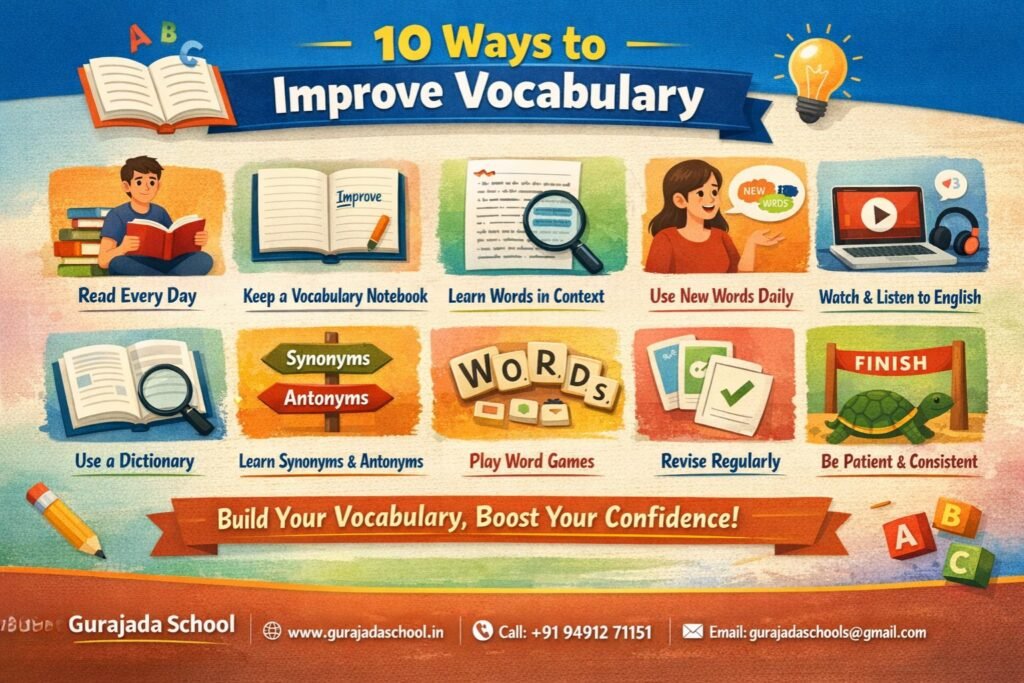
1. Read Every Day
Reading is one of the most powerful and natural ways to improve vocabulary. When you read regularly, you are exposed to new English vocabulary words in meaningful contexts, which makes learning easier and more effective.
What to Read:
- Storybooks or novels
- Newspapers and magazines
- Blogs and online articles
- School or college textbooks
Reading different types of content exposes you to different styles of language. Stories help with conversational words, newspapers improve formal vocabulary, and textbooks introduce academic terms.
Start with simple content that matches your current level and slowly move to advanced material. Do not skip words you don’t know. Try to guess the meaning from the sentence first, then confirm it using a dictionary.
Tip: Reading just 20–30 minutes every day can significantly improve vocabulary skills over time and also enhance comprehension and writing ability.
2. Maintain a Vocabulary Notebook
A vocabulary notebook is a simple yet powerful tool for vocabulary building. Writing words by hand improves memory and helps you remember words longer.
Every time you find a new word, write it down in your notebook.
What to Write:
- The new word
- Its meaning
- One or two example sentences
- Synonyms or related words
Example:
Word: Improve
Meaning: To make something better
Sentence: I want to improve my English vocabulary for better communication.
You can also add pronunciation tips or small drawings if that helps you remember. Review your vocabulary notebook regularly. This habit helps move words from short-term memory to long-term memory and strengthens vocabulary skills.
3. Learn Words in Context
Many learners make the mistake of memorizing word lists without understanding how words are used. This makes it difficult to remember or apply them correctly.
Instead of learning isolated words, learn them in:
- Complete sentences
- Short paragraphs
- Real-life conversations
For example, learning the word “build” alone is less effective than learning phrases like “build confidence”, “build skills”, or “build vocabulary”.
When you learn words in context, you understand their meaning, usage, and tone. This is one of the most effective ways to improve English vocabulary and avoid mistakes.
4. Use New Words in Daily Life
Learning new words is only the first step. To truly improve vocabulary, you must use new words regularly.
Try to:
- Use new words in daily conversations
- Include them while writing messages, emails, or notes
- Make your own sentences
- Think in English using new vocabulary
You may feel hesitant or make mistakes at first, but that is completely normal. Practice builds confidence, and confidence strengthens vocabulary skills.
Remember: A word becomes part of your vocabulary only when you actively use it in real situations.
5. Watch English Videos and Listen Actively
Learning new words is only the first step. To truly improve vocabulary, you must use new words regularly.
Try to:
- Use new words in daily conversations
- Include them while writing messages, emails, or notes
- Make your own sentences
- Think in English using new vocabulary
You may feel hesitant or make mistakes at first, but that is completely normal. Practice builds confidence, and confidence strengthens vocabulary skills.
Remember: A word becomes part of your vocabulary only when you actively use it in real situations.
6. Use a Dictionary Smartly
A dictionary is an essential tool for improving vocabulary, but it should be used wisely.
When you look up a word:
- Read its definition carefully
- Check example sentences
- Learn synonyms and antonyms
- Notice different word forms (noun, verb, adjective)
For example, from the word “create”, you can learn creation, creative, and creatively. This approach helps you learn multiple English vocabulary words from a single root word.
Using a dictionary this way makes vocabulary building faster and more effective.
7. Learn Synonyms and Antonyms
Learning synonyms and antonyms improves vocabulary skills and helps you express ideas more clearly.
Examples:
- Happy – joyful, cheerful, pleased
- Big – large, huge, enormous
Using synonyms avoids repetition and makes your writing and speech more interesting and professional. Antonyms help you understand word meanings more deeply.
Instead of learning random words, focus on word families. This method makes vocabulary building organized and easier to remember.
8. Play Word Games and Puzzles
Vocabulary learning does not have to be boring. Games make learning enjoyable and reduce stress.
Useful Word Games:
- Crossword puzzles
- Word search games
- Scrabble
- Online vocabulary quizzes
These games improve memory, spelling, and word recognition. They are especially helpful for students and beginners who want to improve English vocabulary in a fun and relaxed way.
9. Revise Regularly
Revision is the key to strong vocabulary skills. Without regular revision, new words are easily forgotten.
Simple Revision Methods:
- Review your vocabulary notebook weekly
- Re-read highlighted words from books
- Use flashcards
- Practice online quizzes
Try to revise words multiple times using different methods. Repetition strengthens memory and improves long-term recall.
10. Be Patient and Consistent
Vocabulary building is a gradual process. Do not expect quick results or overnight success. Focus on consistency instead of speed.
Even learning 5 new English vocabulary words per day can lead to:
- 150 words in a month
- 1,800 words in a year
That is a strong improvement over time. Stay motivated, practice daily, and enjoy the learning journey. Slowly but surely, your vocabulary skills will improve.
Common Mistakes to Avoid
While trying to improve vocabulary, avoid these common mistakes:
- Memorizing words without understanding
- Not using new words in daily life
- Learning too many words at once
- Skipping revision
- Being afraid of making mistakes
Mistakes are a natural part of learning. Focus on progress, not perfection.
Final Thoughts
Building vocabulary skills is one of the most valuable investments you can make in your education and career. Strong vocabulary improves communication, confidence, and overall language ability.
By following these 10 practical ways to improve vocabulary, you can steadily build strong vocabulary skills and use English more effectively in real-life situations. Vocabulary building is not about how many words you know, but how well you understand and use the words you learn.
Start today. Stay consistent. And watch your English vocabulary grow day by day.
Conclusion
Building strong vocabulary skills is an essential part of learning English and developing confidence in communication. When students consistently practice reading, listening, speaking, and using new English vocabulary words in daily life, they gain clarity in expression and confidence in thinking. Vocabulary building is not a one-day task; it is a continuous journey that grows with the right guidance, encouragement, and practice.
At Gurajada School, we believe that language learning goes beyond textbooks. Along with academic excellence, we focus on developing vocabulary skills through reading habits, interactive activities, classroom discussions, and creative learning methods. By nurturing curiosity and encouraging students to use language confidently, Gurajada School helps learners improve vocabulary naturally and effectively.
Through structured learning and supportive teaching, students are guided on how to improve English vocabulary in a meaningful way, preparing them not only for exams but also for real-life communication. At Gurajada School, we aim to build strong foundations that empower students to express themselves clearly, think critically, and succeed confidently in the future.